6 Model Diagnostics
Recall once more the notation for our linear model:
For \(n\) observations of \(x\) and \(y\) we have:
\[y_i = \beta_0 + \beta_1 x_i + \epsilon_i\]
\(\epsilon_i \sim N(0,\sigma^2)\) and \(i = 1,...,n\).
The full probability model for \(y_i\) given \(x_i\) can be written as
\[y_i|x_i \sim N(\beta_0 + \beta_1 x_i, \sigma^2)\]
6.1 Assumptions of the Linear Model
When we fit a simple linear regression model there are five main assumptions that have to hold in order for the model to be legitimate. These assumptions are:
Assumption 1: The deterministic part of the model captures all the non-random structure in the data, i.e. the residuals have mean zero.
Assumption 2: The scale of the variability of the residuals is constant at all values of the explanatory variables.
Assumption 3: The residuals are normally distributed.
Assumption 4: The residuals are independent.
Assumption 5: The values of the explanatory variables are recorded without error.
6.2 How to check the assumptions of a Linear Model
Assumption 1: Plot the residuals against the explanatory variable (e.g.
at_bats), or plot the residuals against the fitted values (\(\hat{y}\)). If the first assumption holds, i.e. the residuals have mean zero, then the residuals should be scattered randomly above and below the \(y=0\) line.Assumption 2: Plot the residuals against the fitted values. If the second assumption holds, i.e. the scale of the variability of the residuals is constant at all values of the explanatory variables, then the residuals should be scattered randomly across the \(y=0\) line, with no fanning or any other shape, such as a parabola.
Assumption 3: Plot a histogram of the residuals, or make a QQ-plot. If the third assumption holds, i.e. the residuals are normally distributed, the histogram should appear normally distributed, in the usual bell shape and centred at zero. For the QQ-plot, the points should be as close to a straight diagonal line as possible.
Assumption 4: Difficult to formally examine and often justified on the basis of experimental context.
Assumption 5: Difficult to formally examine and often justified on the basis of experimental context.
6.2.1 Exercise 6
For the linear model of runs against at-bats model, does the assumption that the deterministic part of the model captures all the non-random structure in the data, i.e. the residuals have mean zero, hold?
Run the code below to look at the scatter plot of the model residuals on the y-axis against the fitted values on the x-axis.
ggplot(data = m1, aes(x = .fitted, y = .resid)) +
    geom_point() +
    geom_hline(yintercept = 0, linetype = "dashed") +
    labs(x = "Fitted Values", y = "Residuals")
In the above code, geom_hline() adds a horizontal dashed line at y equals zero.
Does the assumption hold?
6.2.2 Exercise 7
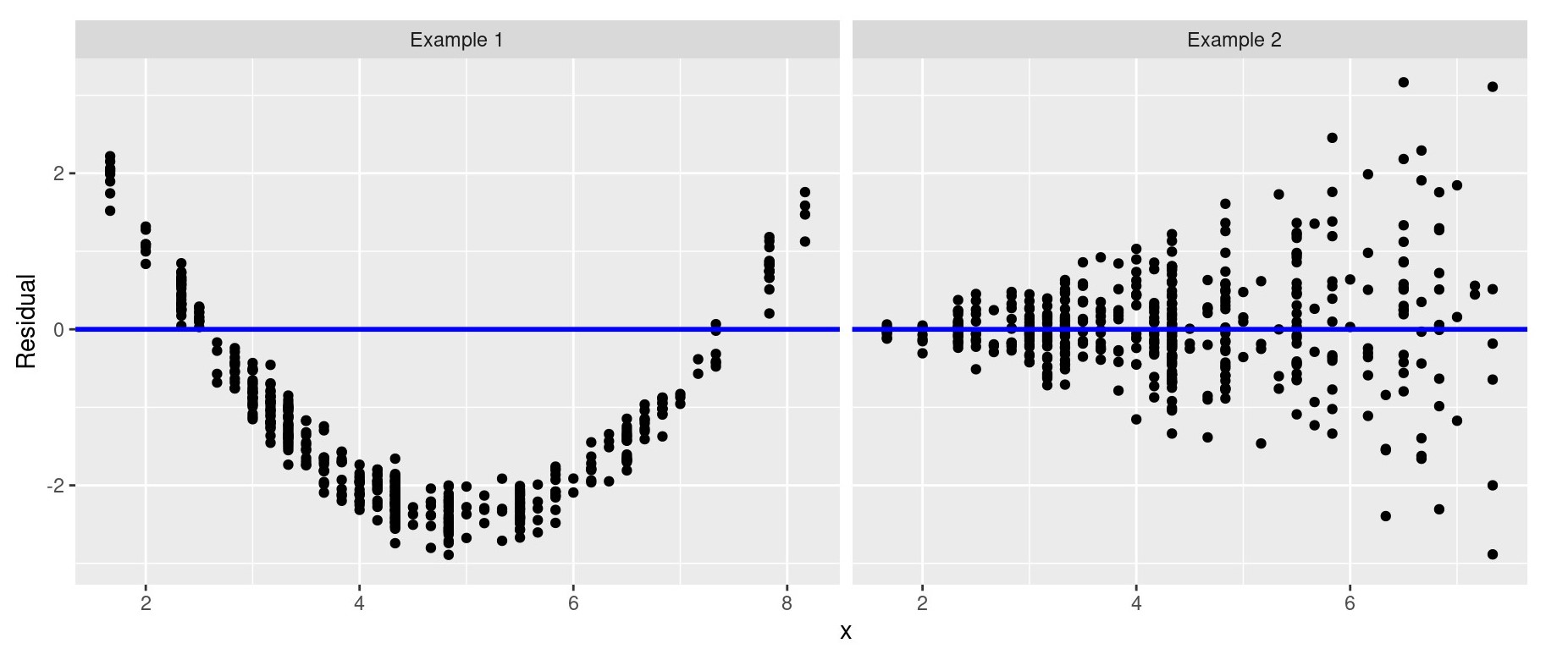
Using the same figure above, for the runs against at-bats model, does the assumption that the scale of the variability of the residuals is constant at all values of the explanatory variables, hold?
See below for some examples of the second assumption not holding.
Exercise 8
For the runs against at-bats model, does the assumption that the residuals are normally distributed, hold?
Run the code below to look at both the histogram and the normal Q-Q plot of the model residuals.
ggplot(data = m1, aes(x = .resid)) +
    geom_histogram(color = "white", binwidth = 40) +
xlab("Residuals")ggplot(data = m1, aes(sample = .resid)) +
stat_qq() +
stat_qq_line()Does the assumption hold?